
Last Updated: October 23, 2026
Quick Summary
Portable toilet rental for weddings ensures guests have access to clean facilities when your venue lacks adequate bathrooms. A common starting point is one restroom unit per 50 guests for a four-hour event, adjusted for factors like open bars, event duration, and existing venue bathrooms. Luxury restroom trailers offer flushing toilets and running water for formal celebrations, while standard portable toilets provide budget-friendly functionality for casual events.
- Start with one unit per 50 guests for four hours, then adjust for open bars, event length, and venue bathrooms.
- Standard portable toilets cost $100-$250 per day; luxury trailers range from $700-$3,000+ per day.
- Request itemized quotes covering delivery, setup, servicing, attendants, and taxes to compare providers fairly.
- Book six to eight weeks ahead during peak season to secure availability and allow time for site assessment.
- Confirm ADA accessibility and arrange a pre-event walkthrough to verify unit placement and functionality.
Table of Contents
- Why Portable Toilet Rental Matters for Weddings
- How Many Porta Potties for a Wedding
- Portable Toilet Rental Cost and Pricing Factors
- Wedding Restroom Trailer Rental vs. Standard Portable Toilets
- Wedding Restroom Rental Checklist
- Delivery, Setup, and Sanitation Standards
- Planning Your Portable Restroom Solution
- Frequently Asked Questions
Why Portable Toilet Rental Matters for Weddings
When your venue lacks adequate bathroom facilities, portable toilet rental for weddings becomes essential to the guest experience.
Most couples focus on catering, flowers, and music, overlooking sanitation until it’s too late, and one guest frustrated by restroom access can dampen the entire event.
Luxury restroom trailers and standard portable toilets serve different needs, budgets, and guest counts.
How Many Porta Potties for a Wedding
The planning chart below converts guest count and event hours into a unit count you can budget against, then shows how alcohol service, venue bathrooms, and guest mix adjust the number.
Start with the base ratio
A common industry starting point is one restroom unit per 50 guests for a four-hour event, assuming light-to-moderate use and no venue bathrooms. That’s a floor, not a ceiling: for long weddings with open bars and no permanent facilities, most planners size closer to one unit per 40-50 guests and then adjust.
Guest count and event duration chart
Use this as a first pass, then apply the adjustments below. Figures assume standard portable toilets; a restroom trailer with multiple stalls counts as several “units” of capacity.
| Guests | 4 hours | 6 hours | 8+ hours |
|---|---|---|---|
| 50 | 1 | 2 | 2 |
| 100 | 2 | 3 | 4 |
| 150 | 3 | 4 | 5 |
| 200 | 4 | 5 | 6-7 |
| 250 | 5 | 6-7 | 8 |
| 300 | 6 | 7-8 | 9-10 |
Read the chart as a baseline for a ceremony-plus-reception event with beer and wine service. Then adjust.
Adjustments that move the number
- Open bar or signature cocktails: Add roughly one unit per 75 guests. Higher alcohol consumption drives more frequent trips and longer lines.
- Existing venue bathrooms: If the venue has two or more working stalls open to guests, you can often drop one unit from the chart. If the venue has only one single-occupancy bathroom, do not subtract, that bathroom becomes a bottleneck, not relief.
- Guest demographics: Weddings with many older guests, pregnant guests, or families with young children tend to need more frequent access. Add a unit when these groups are a large share of the list.
- Dinner service and dancing: Restroom demand spikes after dinner and again late in the reception. A unit count that works at 6 p.m. can fail at 9 p.m.
- Vendor use: Photographers, band members, caterers, and planners also need facilities. Add one unit for events with 10 or more working vendors, or confirm the venue provides staff restrooms.
- Accessible needs: At least one unit should be ADA-accessible when any guest uses a wheelchair or walker. Accessible units take more floor space and are not interchangeable with standard units for planning purposes.
Worked example
A 180-guest outdoor reception, six hours, open bar, no venue bathrooms, 12 vendors on site:
- Chart baseline for 150-200 guests at 6 hours: 4-5 units
- Open bar adjustment: +2 units
- No venue bathrooms: no subtraction
- Vendor use: +1 unit
- Total planning range: 7-8 standard units, or a restroom trailer sized to match
That’s very different from the 3-4 units a simple ratio suggests.
When you are between two numbers, size up. The marginal cost of one extra unit is small compared with the guest-experience cost of running short. Vendors can usually add a unit up to a week or two before the event if inventory allows.
When a trailer changes the math
A restroom trailer is not one unit. A two-stall trailer serves roughly the capacity of two standard units but with flushing toilets and sinks, which shortens visits and moves lines faster; a four-stall trailer can replace five to six standard units for a formal wedding. Ask your provider to translate stall count into the same guest-and-hours math so you compare like with like.
Confirm with a site assessment
Slope, distance from the reception tent, and guest walking patterns all affect how many units feel adequate. Ask the provider to walk the site before you lock the count, a 15-minute visit is the cheapest insurance against undersizing.
Portable Toilet Rental Cost and Pricing Factors
The ranges below are typical planning figures, not quotes, your final number depends on market, date, distance, and services. Use them to build a budget and sanity-check quotes.
Typical price ranges
| Item | Typical range | Notes |
|---|---|---|
| Standard portable toilet | $100-$250 per day | Basic unit; weekend and holiday rates run higher |
| Standard unit, weekend rate | $150-$350 | Friday drop, Monday pickup is common |
| Deluxe portable toilet (sink, interior light) | $175-$350 per day | Hand-wash station often bundled |
| Hand-washing station (standalone) | $75-$200 per day | Multiple-sink units cost more |
| Two-stall restroom trailer | $700-$1,500 per day | Flushing toilets, sinks, lighting |
| Four-to-eight-stall luxury trailer | $1,200-$3,000+ per day | Climate control, premium finishes, attendant space |
| Delivery and pickup | $50-$300 | Scales with distance from the yard |
| Extra servicing visit during event | $75-$200 per visit | Pumping, restocking, cleaning |
| Restroom attendant (per attendant, per hour) | $25-$50 | Often a 4-6 hour minimum |
| ADA-accessible unit surcharge | $25-$100 per unit | Availability varies by provider |
Get itemized quotes.
What actually drives the quote
- Unit type and count. Standard units are cheapest; trailers cost several times more but replace multiple units and carry the upscale experience. Past a handful of units, count matters more than unit price.
- Rental duration. Daily rates are standard, but weekend and multi-day events are often priced as a package. Ask whether a Friday-to-Monday window is billed as one event or three days.
- Delivery distance. Providers usually include a local radius (commonly 15-30 miles) and charge per mile beyond it. A remote venue can add $100-$400 or more. Confirm the radius in writing.
- Site access. Units carried by hand or trailers that can’t reach the placement spot add labor and sometimes a second vehicle. Steep terrain, soft ground, and locked gates all cost money.
- Servicing and restocking. Basic pre-event sanitation is usually included; mid-event pumping, restocking, and cleaning are add-ons. For events over six hours, budget at least one service visit.
- Attendants. An attendant keeps units clean, restocks supplies, and manages lines. This is the single biggest upgrade to guest experience per dollar for formal weddings.
- Date and season. Peak spring and fall Saturdays command premium pricing and sell out early; off-season and weekday dates are often discounted.
- Power and water. Trailers need power (standard outlet or generator) and a water supply or onboard tank. If the venue cannot provide either, generator rental and water delivery are added line items.
How to read an itemized quote
Ask every provider to break the quote into these lines so you can compare fairly:
- Unit rental (type × quantity × duration)
- Delivery and pickup
- Setup and leveling
- Pre-event sanitation and supplies
- Mid-event servicing (number of visits)
- Attendant hours
- Power, water, or generator (trailers)
- ADA unit surcharge
- Taxes and any permit fees
- Cancellation and reschedule terms
A low total that omits delivery, servicing, or attendant hours is not a lower price, it is an incomplete one. Compare totals only after every quote is broken into the same ten lines.
Budget-saving moves that do not hurt guests
- Book off-peak dates or a Friday/Sunday if your schedule allows.
- Bundle units and a hand-washing station from one provider to avoid duplicate delivery fees.
- Choose a trailer sized to your guest count rather than the largest available.
- Skip the attendant for casual daytime events; keep it for formal evening receptions with open bars.
- Confirm the delivery radius before you fall in love with a venue outside it.
Get quotes early
Peak-season inventory tightens months out. Request itemized quotes from two or three licensed providers at least six to eight weeks before the event, and lock the date once the line-item comparison is clear.
Wedding Restroom Trailer Rental vs. Standard Portable Toilets
Restroom trailers and standard portable toilets serve different purposes and budgets.
Standard portable toilets are compact, self-contained, affordable, and require minimal space.
Luxury restroom trailers resemble upscale bathrooms: flushing toilets, sinks with running water, mirrors, lighting, climate control, sometimes tile flooring and granite countertops.
The trade-off is cost and space: trailers need more room for positioning and hookup and cost significantly more.
| Feature | Standard Portable Toilet | Luxury Restroom Trailer |
|---|---|---|
| Toilet type | Vault or pump | Flushing toilet |
| Water access | Hand sanitizer only | Running water, sink |
| Climate control | None | Heated/cooled |
| Space needed | Minimal | Moderate to large |
| Cost per unit | Lower | Higher |
| Best for | Casual events, budget-conscious | Formal weddings, upscale events |
| Guest experience | Functional | Comfortable, elegant |
Wedding Restroom Rental Checklist
- Determine guest count and event duration
- Calculate number of units needed (consult with provider)
- Identify venue location and site access for delivery
- Confirm delivery and setup dates and times
- Choose unit type (standard portable toilet or luxury restroom trailer)
- Request itemized pricing breakdown
- Ask about included services (restocking, cleaning, maintenance)
- Verify sanitation and cleaning standards
- Confirm restroom placement on venue map
- Arrange power and water hookups if needed (for trailers)
- Discuss weather contingencies and backup plans
- Request proof of licensing, bonding, and insurance
Delivery, Setup, and Sanitation Standards
Reliable providers arrive on schedule, position units correctly, and ensure everything functions before guests arrive.
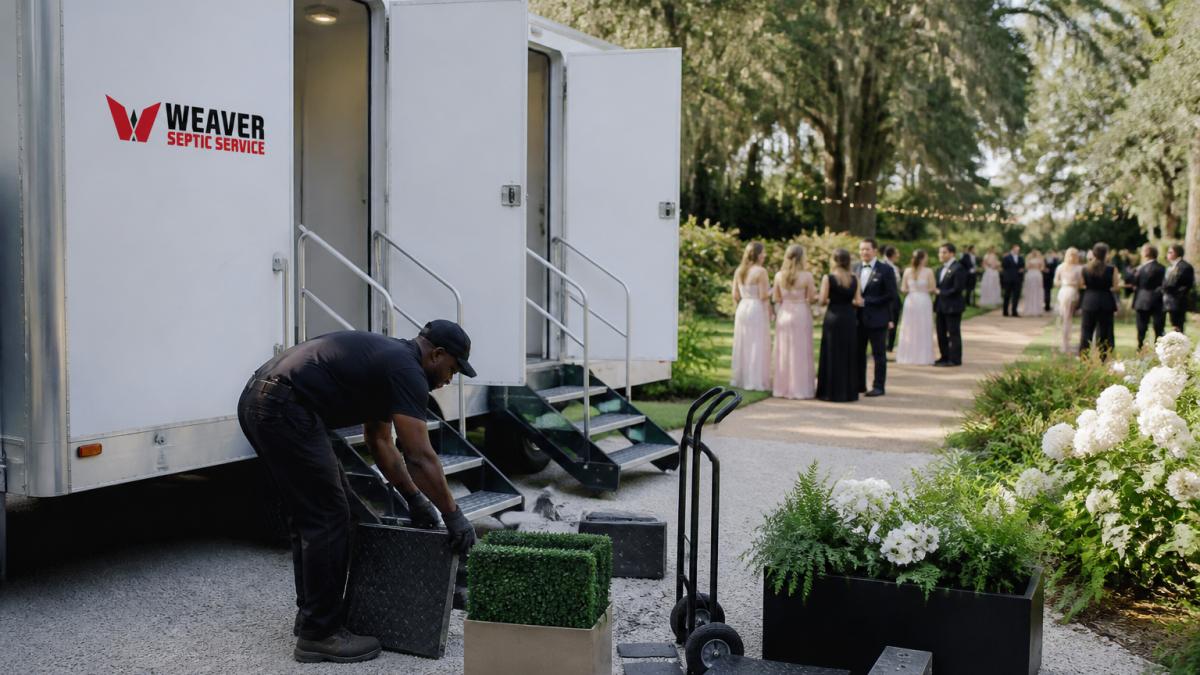
Weaver Septic Service, LLC maintains high sanitation standards for all portable restroom rentals. Our team is licensed, bonded, and insured, ensuring professional, reliable service.
Discuss rain plans, wind, and temperature extremes with your provider. Some trailers include heating or air conditioning, and soft soil may require additional support or repositioning.
Planning Your Portable Restroom Solution
Contact Weaver Septic Service, LLC or other local providers with your venue, guest count, event date, and preferences.
Review quotes carefully.
Confirm accessibility for guests with mobility challenges. Ask whether units meet ADA requirements and can be positioned near parking or main event areas.
Finalize arrangements two weeks before your event: confirm delivery date, time, and contact information, and provide a venue map showing unit placement, power/water access, and site-specific considerations. Do a final walkthrough the day before to verify everything is ready.
Portable toilet rental for weddings shouldn’t add stress, it should ensure every guest has access to clean, comfortable facilities.
Frequently Asked Questions
How many portable toilets do I need for my wedding?
A common rule is one portable toilet per 50 guests for events under 4 hours, or one per 40 guests for longer celebrations. For 100 guests, plan 2-3 units. Account for peak usage times (cocktail hour, dinner service) and consider adding an extra unit if your venue lacks permanent restrooms or if you’re hosting elderly guests or families with children who may need more frequent access. Weaver Septic Service can help you calculate the right capacity for your specific event.
What’s the difference between a portable toilet and a restroom trailer for weddings?
Standard portable toilets are compact, single-unit facilities suitable for outdoor events and worksites. Wedding restroom trailers are larger, multi-stall luxury units with amenities like running water, sinks, mirrors, and climate control. Trailers provide an upscale guest experience and work well for formal celebrations at venues without adequate facilities. Portable toilets cost less and suit casual outdoor events. Your choice depends on guest count, event formality, and budget.
How far in advance should I book portable toilet rentals for my wedding?
Book 4-8 weeks before your event to secure your preferred rental dates and ensure on-time delivery. Peak wedding season (May-October) fills quickly, so earlier booking improves availability. Confirm delivery and setup timing with your rental provider at least 2 weeks prior. Include rental details in your vendor coordination checklist and communicate setup location and site access requirements to the rental company.
What should I include in a wedding restroom rental checklist?
Your checklist should cover: guest count and estimated restroom usage, number and type of units needed, delivery and setup date/time, venue site access and parking for delivery vehicles, placement location away from dining and dancing areas, sanitation schedule during the event, waste disposal and breakdown timing, weather contingencies, and accessibility requirements. Confirm all details with your rental provider in writing, and visit your venue beforehand to identify the best placement that balances guest convenience with discretion.
