
Table of Contents
- How Often to Pump a Septic Tank: The Short Answer
- The Septic Tank Pumping Schedule Most Homes Should Follow
- How Often to Pump a Septic Tank for a Family of 4
- What Changes Your Pumping Frequency: Tank Size, Water Use, and System Design
- Signs Your Septic Tank Needs Pumping
- Septic Tank Pumping Cost and What to Expect During the Visit
- What Pumping Does Not Fix and How to Protect Your System
- Frequently Asked Questions
Last Updated: October 21, 2026
How Often to Pump a Septic Tank: The Short Answer
Most homes should pump septic tank every three to five years (the EPA). That range is the standard guidance from the U.S. Environmental Protection Agency’s septic system guidance, and it holds for a typical household on a conventional system. A family of four with a standard tank usually lands near the three-year mark. A smaller household with a larger tank can stretch toward five.
But here is what most guides get wrong: the three-to-five-year rule is a starting point, not a schedule. Your actual interval depends on tank size, how much water you use, and what an inspector finds when the lid comes off. At Weaver Septic Service, LLC, we treat that range as a baseline and then adjust it to the specific system in front of us.
Below, we’ll show you exactly how to find your real number, spot the warning signs, and know what to expect when the truck arrives.
The three-to-five-year range is a default, not a diagnosis. The only way to set a true pumping schedule is to measure the sludge and scum layers during an inspection.
The Septic Tank Pumping Schedule Most Homes Should Follow
A septic tank pumping schedule is simply a plan for how often solids get removed from the tank. For most homes, that means every three to five years. The schedule matters because a tank is a settling chamber, not a treatment plant. Solids sink, grease floats, and the clear middle layer flows out to the drainfield.
Why the Three-to-Five-Year Rule Exists
The rule exists because solids build up at a predictable pace. Every flush adds a small amount of sludge to the bottom and scum to the top. Over years, those layers eat into the working volume of the tank. Once the combined layers take up too much space, solids escape into the drainfield and clog it.
That is the expensive failure. Pumping on time protects the drainfield, which is the part you cannot easily replace.
How to Measure Sludge and Scum Levels
This is the step most homeowners never see, and it is the one that actually sets your interval. A technician opens the tank and lowers a measuring stick wrapped in white material. The stick shows three zones: sludge at the bottom, clear effluent in the middle, and scum on top.
The rule of thumb is simple. When the sludge and scum together take up a large share of the tank’s liquid depth, it is time to pump. Many pros use the “25 percent” trigger, meaning pump when solids and scum combined reach about a quarter of the tank depth. Ask your technician for the actual measurements, and write them down. Next time, you will know exactly how fast your tank fills.
How Often to Pump a Septic Tank for a Family of 4
For a family of 4, plan to pump septic tank every three years. That is the practical midpoint of the three-to-five-year range for a typical household on a standard tank. A household of four produces a steady load of wastewater, and a tank sized for that home will usually need service in that window.
Household size is the single biggest driver of how fast a tank fills, so it helps to see how the interval shifts as the number of people changes. The table below reflects common practitioner guidance for a conventional system with a tank sized to the home:
| Household size | Typical pumping interval |
|---|---|
| 1-2 people | Every 4-5 years |
| 3 people | Every 3-4 years |
| 4 people | Every 3 years |
| 5 people | Every 2-3 years |
| 6 or more people | Every 2 years, or annually if water use is high |
These intervals assume the tank is properly sized for the home. A family of four on an undersized tank may need service closer to every two years, while the same family on a larger tank with careful water use may stretch toward four. That is why the table is a starting point and the inspection measurement is the final word.
Why More People Means More Frequent Pumping
Each person in a household contributes roughly the same daily volume of wastewater, and with it a steady load of solids. More people means more flushes, more showers, and more laundry. The solids settle as sludge and the grease floats as scum, and both layers eat into the tank’s working volume.
If your household has grown since the tank was last pumped, a new baby, an aging parent moving in, a home office that keeps everyone home during the day, shorten the schedule. If it has shrunk, you may be able to extend it, but only after an inspection confirms the solids are not building faster than expected. Do not assume a smaller household automatically buys you more time; water habits and tank condition matter just as much.
What Changes Your Pumping Frequency: Tank Size, Water Use, and System Design
Pumping frequency shifts with three things: how many people live there, how much water they use, and how the system was built. Two homes with identical families can need very different schedules.
Household Size and Daily Water Usage
Water usage is the variable homeowners control most directly. Long showers, frequent laundry loads, and running the dishwasher half-full all push more water through the tank. More water means less settling time, which means solids move toward the drainfield faster.
Ways to reduce water use and protect the tank:
- Fix running toilets and dripping faucets right away
- Run full loads in the washer and dishwasher
- Spread laundry across the week instead of doing it all in one day
- Watch for guests during holidays, when water use spikes
Tank Capacity and System Design Differences
Tank capacity sets the ceiling on how long you can go between pump-outs. A larger tank holds more solids before it needs service. A smaller tank fills faster, even with a careful household.
System design matters too. Conventional gravity systems, aerobic systems, and mound systems all behave differently. Some designs need more frequent inspection and pumping than others. If you are unsure what you have, ask a licensed provider to identify the system type and recommend an interval based on the design, not just the household size.
Signs Your Septic Tank Needs Pumping
The clearest signs a septic tank needs pumping are slow drains, gurgling pipes, sewage odors, and wet spots over the drainfield. Any one of these means the system is struggling and needs a look.
Watch for these warning signs:
- Slow drains in multiple fixtures, not just one
- Gurgling pipes after flushing or running water
- Sewage odors inside the home or near the tank
- Wet spots or standing water over the drainfield
- Backups into tubs or floor drains
One slow drain is often a local clog. Several slow drains at once usually points to the tank. Do not wait for a backup to call. A backup means wastewater is already where it should not be.
Ignoring early signs like gurgling or odors lets solids reach the drainfield. Drainfield damage is far more costly to fix than a routine pump-out.
Septic Tank Pumping Cost and What to Expect During the Visit
Septic tank pumping cost depends on tank size, lid access, and how deep the tank sits. Pricing depends on tank size, lid access, and how deep the tank sits. We quote each job after we see the access and tank size, so ask for a clear estimate up front and confirm what it includes.
The biggest cost drivers are:
- Tank size, a larger tank holds more waste and takes longer to pump
- Lid access, exposed lids cost less than buried or deep-set lids that must be located and uncovered
- Condition, a tank that has gone many years without service may hold more solids and require extra handling
- Distance and disposal, hauling and disposal fees vary by provider and location
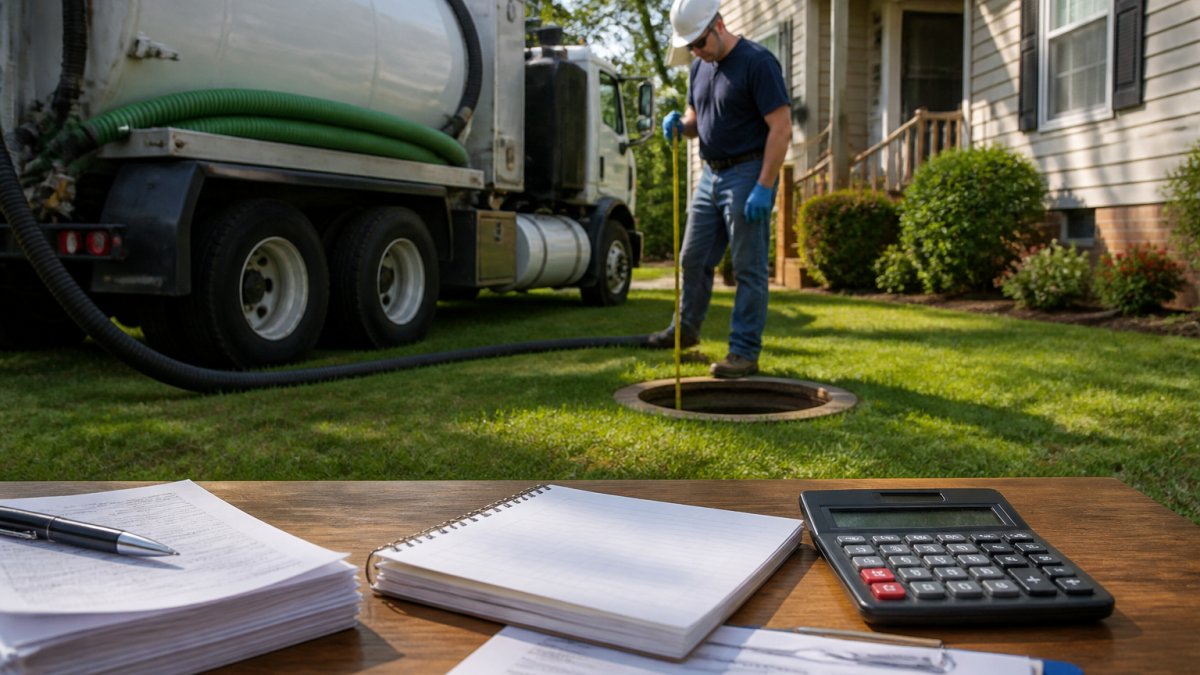
Here is what a pumping visit typically involves:
- Locate and uncover the tank lid, and note the depth and condition of the access
- Inspect the tank and measure sludge and scum levels with a measuring stick
- Pump out the contents into a vacuum truck for proper disposal
- Check the inlet and outlet baffles for damage or blockage
- Recommend the next service date based on the measurements and household load
Expect the visit to take roughly an hour for a standard tank, longer if lids are buried or the tank has gone too long without service. Ask the technician for the sludge and scum measurements before they leave, and keep a record of the date, the measurements, and any baffle or lid issues noted.
Ask for a written estimate that separates the pump-out from any extra charges for digging, lid repair, or baffle replacement. A clear quote up front prevents surprises.
What Pumping Does Not Fix and How to Protect Your System
Pumping removes solids from the tank. It does not repair a clogged drainfield, fix broken baffles, or correct a failing system. If the drainfield is already saturated, pumping alone will not solve the problem. That is why timing matters so much: pumping on schedule prevents the damage that pumping cannot undo.
To protect your system between visits:
- Never flush wipes, grease, or chemicals
- Keep heavy vehicles off the drainfield
- Direct roof and surface water away from the tank
- Schedule an inspection alongside each pump-out
Our team at Weaver Septic Service, LLC is licensed, bonded, and insured, and we handle both residential and commercial systems. If you are unsure when your tank was last pumped, an inspection will tell you where you stand.
Write the date and the sludge measurement on the inside of the tank lid or in a maintenance file. The next technician can then calculate your fill rate and set a precise interval instead of guessing.
Frequently Asked Questions
How often should you pump a septic tank?
Most households should pump every three to five years, but that range shifts with tank size and occupancy. A two-person home with a 1,000-gallon tank may stretch to four or five years, while a family of six could need pumping every two to three years. The reliable way to set your interval is to have the tank inspected, measure the sludge and scum layers, and let those readings, not the calendar alone, decide the next pump-out date.
How often should a family of four pump a septic tank?
A family of four in a home with a 1,000-gallon tank should plan on pumping every two to three years. Four people generate roughly 300 to 400 gallons of wastewater a day, which fills the solids layer faster than a smaller household would. If your tank is 1,250 gallons or larger, you may reach three to four years. Confirm with an inspection that measures sludge depth before locking in the schedule.
What factors affect how often a septic tank needs pumping?
Household size, daily water usage, tank capacity, and system design are the main variables. More occupants and heavy water use from long showers, laundry marathons, or running toilets push solids into the tank faster. Garbage disposals add solids, and older or undersized tanks fill sooner. A septic tank pumping schedule should reflect your actual occupancy and tank size, not a generic number, so ask your provider to measure sludge levels at each visit.
What are the signs that a septic tank needs to be pumped?
Watch for slow drains throughout the house, gurgling pipes, sewage odors indoors or around the tank, and wet spots or standing water over the drainfield. Backup into the lowest fixtures is a late warning sign. None of these should be ignored, because a full tank can push solids into the drainfield and turn a routine pump-out into a repair bill. If you notice any of them, schedule an inspection and pumping visit promptly.
A tank that backs up or a drainfield that stays wet needs attention now, not next year. Weaver Septic Service, LLC provides septic tank pumping, inspections, and repairs for homes and businesses, backed by licensed, bonded, and insured professionals. Get started with Weaver Septic Service, LLC and put your system on a schedule that protects it for the long run.